
The Hidden Risks of Managing Incidents on Spreadsheets
For many safety teams, spreadsheets are the starting point for incident tracking. An Excel file gets created, a few columns are added, and incidents begin filling the rows. At first, it feels efficient. Everyone understands spreadsheets. There is no new system to learn.
But as incident volumes grow, cracks begin to appear.
Files multiply. Investigations become harder to track. Important details get buried somewhere between email attachments and shared folders. What began as a quick solution slowly turns into a fragile system holding critical safety information.
The problem is not that spreadsheets are bad tools. They simply were not designed to manage complex safety processes.
Why Many Safety Teams Still Use Spreadsheets
Before looking at the risks, it helps to understand why spreadsheets remain common in incident tracking.
In many organizations, the first incident log is created almost casually. A safety officer opens Excel, adds columns for date, location, incident type, and remarks, and starts recording events. The process works well enough for a small team or a single site.
Spreadsheets offer a few advantages that make them appealing:
- They are familiar to almost everyone in the workplace
- They require no additional software investment
- Files can be created and modified quickly
- Teams can start logging incidents immediately
For small operations, this setup may function for quite some time.
The challenge begins when the organization grows. More sites, more workers, more contractors, and more incidents start entering the log. What once looked organized slowly becomes difficult to manage.
At that point, the spreadsheet is no longer just a simple tool. It becomes the backbone of incident management, even though it was never built for that purpose.
Lack of Real-Time Visibility

One of the biggest limitations of spreadsheets is the absence of real-time visibility.
Incident logs usually exist as files. They may sit on someone’s computer, inside a shared drive, or buried in an email chain. When a new incident occurs, the information often travels through several hands before it reaches the central spreadsheet.
This delay creates a blind spot.
Safety managers may not know about an incident until hours or even days later. During that time, corrective actions may already be overdue or the situation may have escalated.
In environments where hazards change quickly, delayed reporting weakens the organization’s ability to respond quickly and prevent further incidents.
Version Control Problems
Anyone who has worked with spreadsheets for long enough has seen this happen.
Multiple versions of the same file begin circulating. Someone downloads the spreadsheet, updates it, and saves a new copy. Another person edits an older version stored in a shared folder.
Soon the organization ends up with several files that all claim to be the latest incident log.
This leads to common problems such as:
- Duplicate incident entries
- Missing details or attachments
- Outdated corrective action status
- Conflicting information across files
When an audit or investigation requires a complete incident record, teams often spend hours reconciling data from different versions of the spreadsheet.
The time spent managing the file sometimes becomes greater than the time spent analyzing the incidents themselves.
Investigation Tracking Becomes Difficult

Recording an incident is only the first step in effective incident management.
A proper safety process typically includes investigation, root cause analysis, corrective actions, and follow-up verification. Each stage involves different people and deadlines.
Spreadsheets struggle to manage this kind of workflow.
Safety teams often try to add extra columns to track actions or investigation status. Over time the spreadsheet grows wider and more complex, yet it still lacks a structured way to assign tasks or monitor progress.
As a result, investigations may stall. Actions may be assigned but never followed up. Some incidents remain open longer than expected simply because there is no automated system ensuring that the process moves forward.
Limited Ability to Identify Patterns
Incident logs are meant to do more than store records. They should reveal patterns that help prevent future incidents.
Safety managers often want answers to questions like:
- Are certain sites reporting more incidents than others?
- Are specific hazards appearing repeatedly?
- Are near misses increasing in certain operations?
Spreadsheets technically allow data analysis, but extracting meaningful insights requires time and advanced knowledge of formulas or pivot tables.
In reality, many organizations simply log incidents and move on. The data exists, but the patterns remain hidden.
Without clear visibility into trends, opportunities for prevention are easily missed.
Compliance and Audit Challenges
Incident records often play an important role during regulatory inspections or internal audits.
Auditors typically expect clear documentation that shows:
- When the incident was reported
- Who conducted the investigation
- What the root cause was
- Which corrective actions were implemented
Spreadsheets can store this information, but they rarely provide a reliable audit trail. Data can be edited without leaving a trace. Attachments may be stored elsewhere. Investigation updates may appear incomplete.
When records are scattered across multiple files and folders, compiling a complete incident history becomes difficult.
Even if the information exists, demonstrating it during an audit can take considerable effort.
Collaboration Gaps Across Teams
Incident management rarely involves a single individual.
Supervisors report the incident. Safety officers investigate. Managers approve corrective actions. Contractors or workers may also contribute information.
Spreadsheets require these participants to exchange files or emails to stay aligned. Each update relies on someone manually editing the document and sharing the revised version.
This process slows down collaboration.
Important details may remain with one person instead of being visible to the entire team. In some cases, decisions are made without full visibility of the incident history.
For safety teams trying to respond quickly to risks, this fragmented communication can become a serious limitation.
How Safetymint Improves Incident Management
Modern safety teams are gradually moving away from spreadsheets and adopting dedicated incident management systems.
Safetymint is one such platform designed specifically to help organizations report, investigate, and track incidents in a structured way.
Instead of relying on static files, incidents are captured through a centralized digital platform. Workers or supervisors can report incidents directly from a web or mobile interface. Photos, location details, and descriptions can be added instantly.
Once an incident is logged, the system automatically triggers the next steps in the workflow. Investigations can be assigned, root causes documented, and corrective actions tracked until closure.
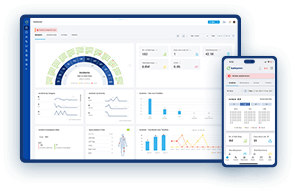
Dashboards also help safety managers monitor incident trends across locations, departments, and hazard categories. This allows organizations to move from reactive reporting toward proactive risk prevention.
Most importantly, every action taken within the system is recorded, creating a clear and reliable audit trail.
Spreadsheet vs Safetymint for Incident Management
| Feature | Spreadsheet-Based Tracking | Safetymint Incident Management |
|---|---|---|
| Incident reporting | Manual entry in Excel files | Web and mobile reporting |
| Visibility | Limited visibility across teams | Real-time dashboards |
| Investigation workflow | Tracked manually through columns | Structured investigation workflows |
| Corrective action tracking | Difficult to monitor deadlines | Automated action tracking |
| Version control | Multiple file versions common | Single centralized system |
| Data analysis | Manual analysis required | Built-in analytics and trends |
| Collaboration | File sharing and emails | Multi-user collaboration |
| Audit readiness | Limited traceability | Complete digital audit trail |
Safety teams rarely start with the intention of managing incidents through spreadsheets forever. Yet many organizations stay with them longer than they should. As incident volumes increase and compliance expectations grow, relying on spreadsheets quietly introduces operational risks that are easy to overlook.
Moving to a structured incident management platform such as Safetymint helps organizations capture incidents faster, track investigations more effectively, and turn safety data into insights that support better decisions.
This article was generated with the assistance of AI and reviewed by Ben Johnson for accuracy and quality.

Ben Johnson is a dedicated Customer Success Executive at Safetymint. With a strong commitment to excellence, Ben works closely with customers to ensure they fully leverage the capabilities of Safetymint to its fullest potential, aiming to significantly reduce or mitigate safety risks and incidents.