4 Popular Risk Analysis Methods and When to Use Them
A good risk analysis begins with a simple question: what could go wrong?
Finding the answer, however, isn’t always that simple. A maintenance crew preparing to work on a conveyor belt will look at risks very differently from a team of process engineers evaluating a chemical reactor. While the former might need to examine the hazards associated with each step of the job, the latter may need to study what happens when pressure, temperature or flow deviates from normal operating conditions.
This is where different risk analysis methods come into play. Some are relatively straightforward and can be carried out on the shop floor, while others involve detailed technical assessments and discussions among specialists.
In this blog, we’ll look at four popular methods used in risk analysis: Job Safety Analysis (JSA), Failure Modes and Effects Analysis (FMEA), Hazard and Operability Study (HAZOP) and the Bowtie Method. We’ll explore how each works, with practical examples to help you understand when and where to use them.
1. Job Safety Analysis (JSA)
Job Safety Analysis is one of the most widely used risk analysis methods at the operational level. It involves breaking down a job into individual steps, identifying the hazards associated with each step and determining the controls needed to minimize those risks.
Take the case of a maintenance technician replacing a conveyor belt. The job involves isolating the power supply, removing machine guards, replacing the belt and testing the equipment. Each step carries its own risks, from unexpected machine startup to pinch points and manual handling injuries. A JSA helps identify these hazards beforehand and establish appropriate controls, such as lockout/tagout (LOTO) and the use of suitable lifting equipment.
JSA works best when the people who actually perform the job are involved in the assessment. Their hands-on experience often brings to light hazards that might otherwise go unnoticed.
The method is particularly useful for construction, equipment maintenance, manufacturing operations and non-routine tasks.
2. Failure Modes and Effects Analysis (FMEA)

Failure Modes and Effects Analysis takes a more technical approach to risk analysis. It involves examining individual components, equipment or processes to understand how they could fail, what might cause the failure and what impact it could have on operations and safety.
Consider a cooling pump in a manufacturing plant. A motor failure, a blocked inlet or a damaged seal could affect its performance. Depending on the application, a pump failure could lead to equipment overheating, production downtime or a serious safety incident.
FMEA typically evaluates potential failures based on three factors: the severity of the consequences, the likelihood of occurrence and the ability to detect the failure before it causes harm. This helps teams prioritize risks and determine where preventive measures are needed.
The method is widely used in manufacturing, automotive, aerospace and equipment reliability management.
3. Hazard and Operability Study (HAZOP)
HAZOP is a structured risk analysis method used to identify hazards and operational problems arising from deviations in normal process conditions. It typically involves a multidisciplinary team examining process parameters such as temperature, pressure, flow and liquid levels.
In a chemical processing plant, for instance, what happens if the temperature inside a reactor rises beyond its operating limit? Could a cooling system failure or a faulty temperature sensor be responsible? What safeguards are in place to prevent an uncontrolled reaction?
During a HAZOP study, teams use guide words such as “No,” “More,” “Less” and “Reverse” to systematically explore possible deviations, their causes and consequences. Existing safeguards are reviewed, and additional controls are recommended wherever necessary.
HAZOP is particularly useful in chemical plants, oil refineries, pharmaceutical facilities and other process-intensive industries.
4. Bowtie Method
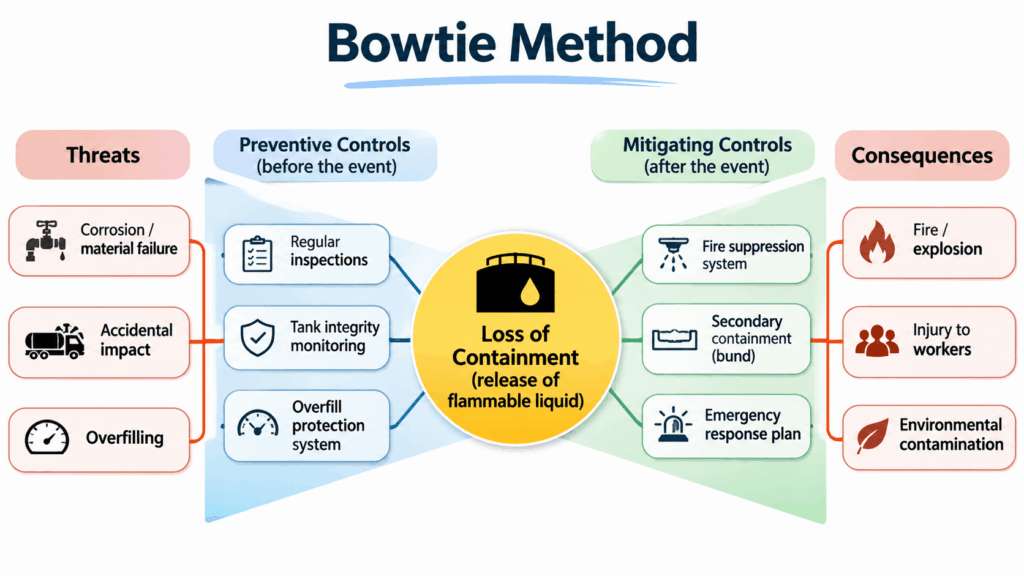
The Bowtie Method provides a visual way of understanding how a hazardous event could occur, what its consequences might be and where safety controls fit into the picture. The diagram resembles a bow tie, with threats on the left, a loss-of-control event at the center and potential consequences on the right.
Imagine a facility that stores flammable liquids. Corrosion, accidental impact or overfilling could result in a loss of containment, potentially leading to a fire, worker injuries or environmental contamination.
Preventive controls, such as tank inspections and overfill protection systems, are placed on the left side of the diagram. Mitigating controls, such as secondary containment and fire suppression systems, appear on the right to show how the consequences can be limited.
One of the biggest advantages of the Bowtie Method is its simplicity in communicating complex risks. It is particularly useful in high-risk industries such as oil and gas, mining, aviation and chemical processing, where understanding the role of individual safety barriers is critical.
Choosing the Right Risk Analysis Method
The choice of risk analysis method depends largely on the nature of the work and the risks involved. In many workplaces, a combination of these methods may be more effective than relying on a single approach. Whichever method you choose, its real value lies in how well the findings translate into practical safety measures on the ground.
This article was generated with the assistance of AI and reviewed by Ben Johnson for accuracy and quality.