Risk Assessment Matrix: How to Use It
Two safety officers assess the same maintenance task. One rates the risk as moderate, while the other considers it high. Both use the same 5×5 risk assessment matrix. So why the difference?
A risk matrix may look straightforward, but assigning likelihood and severity scores requires careful judgment. An inaccurate rating can lead to inadequate controls or unnecessary restrictions on work.
Understanding how to score risks consistently, interpret the results, and reassess them after applying controls makes the matrix far more useful on the job.
What Is a 5×5 Risk Assessment Matrix?
A 5×5 risk assessment matrix is a scoring tool used to evaluate workplace hazards based on two factors: likelihood and severity.
Likelihood measures how likely an incident is to occur, while severity considers how serious its consequences could be. Each is rated on a scale of 1 to 5.
The two ratings are multiplied to calculate a risk score between 1 and 25.
Risk Score = Likelihood × Severity
For example, a hazard rated 3 for likelihood and 4 for severity receives a risk score of 12.
The score helps determine which hazards need attention and how urgently controls should be implemented. However, the numerical rating alone doesn’t decide whether work is safe to proceed. That depends on the nature of the hazard, the effectiveness of existing controls, and the organization’s risk acceptance criteria.
Understanding the 5×5 Risk Matrix
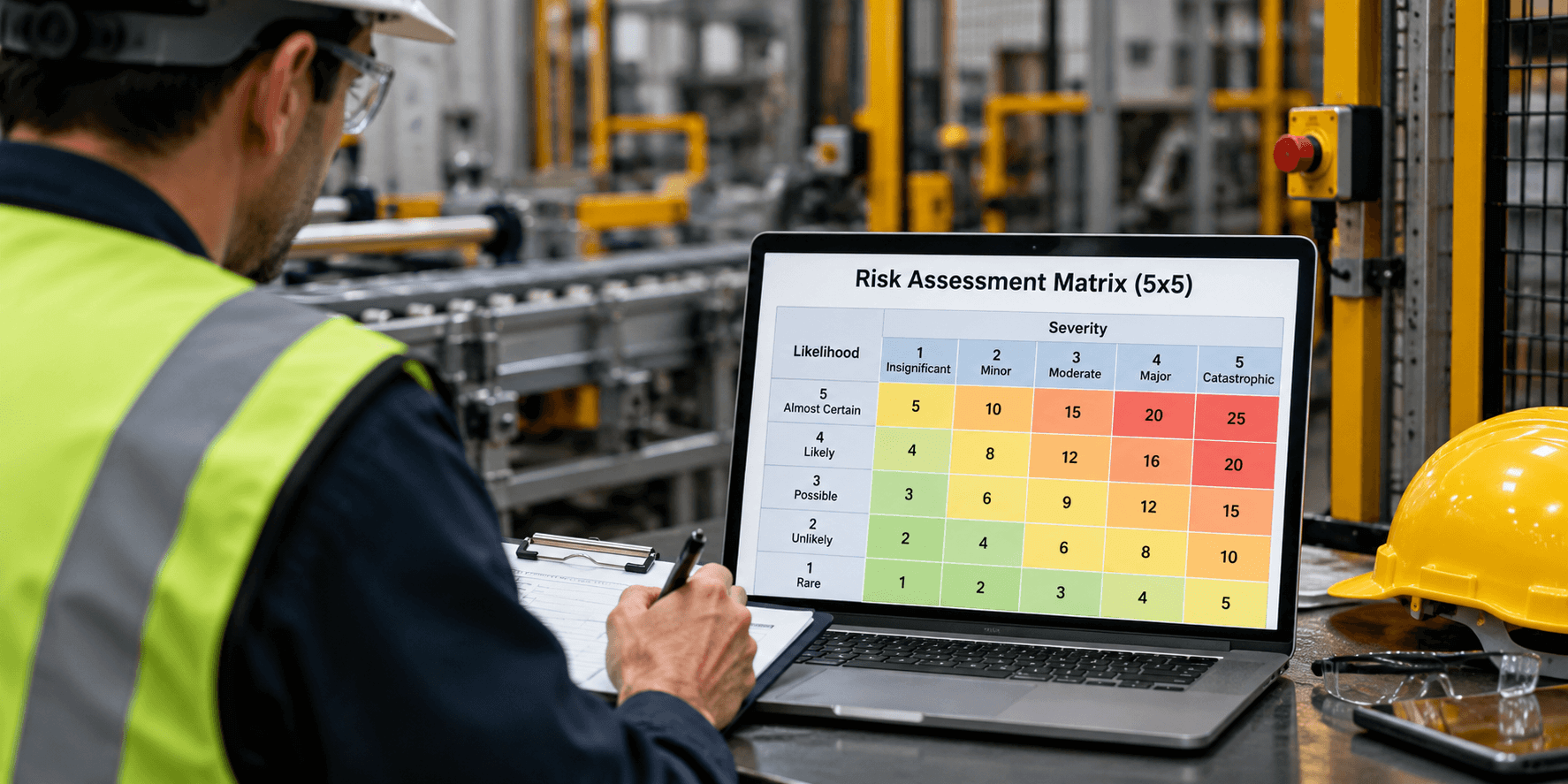
The matrix has five likelihood levels and five severity levels. Their intersection gives the risk score.
5×5 Risk Assessment Matrix
Illustrative scoring bands. Organizations may define different risk categories and acceptance criteria.
The likelihood scale typically runs from rare (1) to almost certain (5), while severity ranges from insignificant (1) to catastrophic (5).
For instance, a hazard with a likelihood of 4 and severity of 5 receives a score of 20, placing it in the extreme-risk category in the example above.
Before using any matrix, check your organization’s scoring definitions. A rating of 3 should mean the same thing to everyone conducting the assessment.
How to Use a 5×5 Risk Assessment Matrix: A Practical Example

Consider a maintenance technician assigned to repair a conveyor belt in a manufacturing facility. The equipment could start ;unexpectedly while the technician is working on it.
Here’s how the supervisor might assess the risk.
Step 1: Identify the Hazard
The immediate concern is unexpected conveyor movement, which could trap or crush the technician’s hand.
The assessment should consider the equipment’s operating condition, available safeguards, maintenance procedures, and any stored energy.
Step 2: Assign Likelihood and Severity Scores
Suppose the conveyor has no effective isolation in place and could be restarted from a remote control panel.
For this illustrative assessment, the supervisor assigns:
- Likelihood: 3 (Possible), considering the existing conditions.
- Severity: 5 (Catastrophic), because unexpected movement could cause a fatal injury.
The initial risk score is 3 × 5 = 15 (High).
These ratings are examples. Actual scores must reflect site conditions and the organization’s approved criteria.
Step 3: Select and Implement Controls
Before maintenance begins, the team must establish effective energy isolation. Controls include locking out the equipment, identifying and isolating all relevant energy sources, releasing stored energy, and verifying that the conveyor cannot move unexpectedly.
Workers must also understand who is authorized to remove locks and how the equipment will be safely restarted.
Step 4: Calculate the Residual Risk
Once the controls are implemented and verified, the likelihood of unexpected startup should be substantially lower.
Assume the likelihood falls from 3 to 1, while the severity remains 5.
The residual risk score becomes 1 × 5 = 5 (Moderate).
| Assessment | Likelihood | Severity | Score |
| Before controls | 3 | 5 | 15 |
| After verified controls | 1 | 5 | 5 |
The reduced score does not automatically authorize the work. The supervisor must confirm that the isolation is effective and that the residual risk meets the organization’s acceptance criteria.
What Does the Risk Score Actually Tell You?
Risk scores help prioritize hazards, but two hazards with identical scores may require different decisions.
Consider a minor injury that is almost certain to occur (5 × 2 = 10) and a potentially fatal event considered unlikely (2 × 5 = 10).
Both receive a score of 10. Yet the potential consequences are very different.
A 5×5 matrix also relies on judgment. Its scores are ranking aids, not precise measurements of probability. A score of 20 doesn’t necessarily mean twice the risk of a score of 10.
For hazards with catastrophic consequences, organizations may require additional safeguards or senior-level approval regardless of the numerical rating.
Common Mistakes When Using a 5×5 Risk Matrix
Even experienced safety professionals can arrive at misleading scores when assessments become routine. Some common mistakes include:
- Guessing likelihood: Ratings should reflect actual exposure, equipment conditions, incident history, and the reliability of existing controls.
- Reducing severity after introducing controls: Lockout/tagout may reduce the likelihood of unexpected startup, but the potential consequences of a failure can remain catastrophic.
- Overestimating control effectiveness: A written procedure offers little protection if workers aren’t following it.
- Treating low scores as permission to proceed: Mandatory safety requirements still apply, regardless of the score.
- Using inconsistent scoring criteria: If one department considers an event unlikely and another rates the same conditions as possible, comparisons become unreliable.
A useful practice is to have supervisors and workers review assessments together, particularly for unfamiliar or high-risk tasks.
When Should You Review a Risk Assessment?

A risk assessment completed six months ago may no longer reflect today’s working conditions.
Consider reviewing the assessment when:
- Equipment, materials, or operating procedures change.
- An incident or near miss reveals an overlooked hazard.
- Existing controls prove ineffective.
- Contractors or new work activities introduce additional risks.
Risk scores should also be revisited during Permit to Work reviews and Job Safety Analysis (JSA) discussions when conditions change.
For example, a maintenance activity initially assessed under normal operating conditions may require reassessment if nearby production activities introduce additional hazards.
Making Risk Assessments Useful Beyond the Form
A completed matrix is useful only when its findings influence how work is performed.
Supervisors need to know which controls are required, who is responsible for implementing them, and whether they have been verified before work begins.
Digital tools can make this easier to manage. Safetymint’s HIRA software supports structured hazard identification and risk assessment, while its risk assessment software helps organizations manage assessments and related safety activities.
The real test of a 5×5 risk assessment matrix comes when someone questions a score, challenges an assumption, or identifies a missing control. A good assessment should stand up to that scrutiny and give the team enough information to make a defensible decision.
This article was generated with the assistance of AI and reviewed by Ramesh Nair for accuracy and quality.