
Safety Records: More Than Proof of Compliance
A near miss gets reported during the morning toolbox talk. A damaged guardrail, a leaking valve, a forklift that came a little too close to someone. The problem is fixed, everyone moves on.
Six months later, something similar happens. Only this time, someone gets hurt.
Now the questions begin. Has this happened before? Was it reported? What was done about it?
If the answers depend on someone’s memory, there is already a problem.
Good safety record keeping isn’t just about having documents ready for an audit. It gives a workplace a memory. Done well, those records can reveal recurring hazards, unfinished corrective actions and warning signs that are surprisingly easy to miss when each event is viewed on its own.
Safety Records Are Your Workplace’s Memory
People move on. Supervisors change. Contractors finish their work. Even the details of a serious incident become surprisingly fuzzy with time.
Records don’t.
An incident report captures what happened. An inspection records what was found. A risk assessment shows what was considered before work began. A corrective action tells us whether an identified problem was actually dealt with.
Put together, these records create something valuable: a history of how risk has behaved in your workplace.
That history becomes particularly useful when something starts repeating. Three reports of damaged electrical cables from different parts of a site may look unrelated. Several near misses involving reversing vehicles may each be dismissed as one-off events. Viewed together, they tell a different story.
This is where good record keeping earns its place. It allows safety teams to stop looking at events in isolation and start asking a better question: Is there a pattern here that we’re missing?
What Safety Records Are Worth Keeping?

There is no shortage of paperwork in safety. The answer isn’t to record everything simply because you can.
The useful records are those that help establish what happened, what risks were identified, what controls were put in place and what happened afterwards.
Depending on the workplace, that could include:
- Incident, injury and near-miss reports
- Hazard and unsafe-condition observations
- Risk assessments, HIRA and JSA records
- Permit to Work records
- Inspection and audit findings
- Corrective and preventive actions
- Training and competency records
- Toolbox talks and safety meeting records
- Equipment inspection and maintenance history
- Contractor safety records
Each answers a different question. Training records tell you whether someone was prepared for a task. Permit records show the controls agreed before hazardous work began. Inspection history can reveal whether the same deficiency keeps returning.
The value isn’t in the number of records collected. It’s in the connections between them.
Record Keeping Should Help You Spot Trouble Earlier
This is where safety record keeping becomes more than administration.
Imagine a warehouse records six near misses involving forklifts over nine months. No one is injured. Each event is investigated separately and each gets a relatively minor corrective action.
Nothing looks particularly alarming.
But put those six records on a timeline and something may jump out. Perhaps five happened during shift changes. Four involved the same loading area. Or most involved temporary workers unfamiliar with pedestrian routes.
That’s information you can act on.
The same principle applies elsewhere. Inspection records may show one machine repeatedly failing the same check. Permit records may reveal recurring isolation problems. Corrective-action data may show that one department routinely misses closure deadlines.
A well-kept safety record doesn’t just answer “What happened?”
It helps answer “Why does this keep happening?”
When Something Goes Wrong, Records Become Evidence
After a serious workplace incident, recollections can become unreliable very quickly.
One person remembers that the equipment was inspected. Another thinks the inspection was due the following week. Someone recalls discussing the hazard at a toolbox meeting, but nobody is certain when. The supervisor who handled it may have moved to another project.
Good records remove much of that uncertainty.
They can establish a timeline:
When was the hazard identified? Who reviewed it? What control was recommended? Who was responsible? Was the action completed? Was there evidence of closure?
This matters during internal investigations, audits, insurance reviews and regulatory inspections. It also matters when an organisation needs to demonstrate that its own safety procedures were actually followed.
Of course, records can expose uncomfortable facts too.
If an inspection identified a damaged guardrail three weeks before a fall and the corrective action remained open, the record isn’t helping the organisation’s defence. It is showing where the system failed.
That’s precisely why accurate records matter. Their job isn’t to make the organisation look good. Their job is to show what actually happened.
More Records Don’t Necessarily Mean Better Safety
There is a trap here.
A company can have thousands of completed forms and still have poor safety record keeping.
Consider an incident description that simply says, “Employee advised to be more careful.” What does that tell the next safety manager who reads it a year later?
Very little.
The same problem occurs when hazards are classified inconsistently, corrective actions are closed without evidence, photographs are stored in someone’s phone, inspection spreadsheets sit on individual laptops, or identical problems are described differently by every site.
The records exist, but they aren’t particularly useful.
Poor-quality safety data creates false confidence. A dashboard built on incomplete or inconsistent records doesn’t suddenly make the information reliable. It simply presents bad information more neatly.
What Does a Good Safety Record Look Like?
You don’t need a complicated rulebook.
For most safety events, the record should make it easy for someone who wasn’t there to understand:
What happened? Where did it happen? When? Who was involved or responsible? What action was taken?
For corrective actions, add another question:
How do we know the problem was actually fixed?
That last question is often overlooked.
Closing an action because someone clicked “complete” isn’t the same as verifying that a control works. A photograph, inspection result, approval or follow-up observation can provide the missing evidence.
Consistency matters too. Use common categories and terminology. Assign clear owners. Record dates. Attach relevant photographs and documents. Keep approvals traceable.
Months later, someone should be able to reconstruct the story without having to track down three supervisors and search through an old email chain.
From Filing Records to Using Them
Paper forms aren’t automatically bad. Neither are spreadsheets.
The problem starts when safety information becomes fragmented.
An incident may be recorded in one spreadsheet. Photographs are sent over email. The investigation becomes a PDF. Corrective actions sit in another tracker. Training records are somewhere else entirely.
Technically, everything has been recorded. Practically, the story has been broken into pieces.
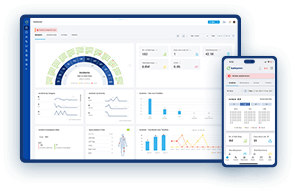
This is where digital safety management systems can make record keeping far more useful. An incident can be connected to its investigation, root cause, corrective actions, supporting evidence and eventual closure. Inspection findings can become actions. Permit records can retain approvals, extensions and handovers. Trends can be analysed across sites, departments or contractors.
Platforms such as Safetymint can help organisations maintain this traceability while giving safety teams a searchable history rather than another archive of completed forms.
The real advantage isn’t simply going paperless.
It’s being able to find the information when it matters.
A Safety Record Is Only Valuable If Someone Uses It
Go back to that near miss from the beginning.
Recording it proves that someone reported the problem. That’s useful.
But that isn’t its real value.
Its value comes months later, when another report describes something similar and somebody notices the connection. Or when an inspection shows that the same control has failed again. Or when a safety manager reviews the data and decides to intervene before there is an injury.
That’s the difference between keeping safety records and using safety records.
One creates an archive.
The other creates an opportunity to learn from what has already happened, while there is still time to prevent what happens next.
This article was generated with the assistance of AI and reviewed by Ramesh Nair for accuracy and quality.