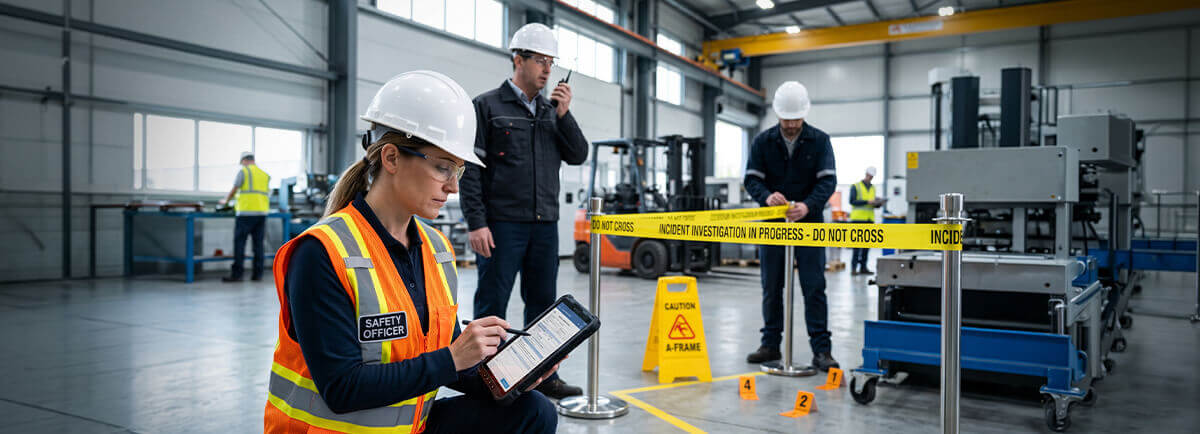
The First 24 Hours of Incident Response
A workplace incident can unfold in seconds, but the decisions made in the hours that follow often determine the outcome of the investigation.
Once the injured person has received assistance, supervisors and safety teams face a different challenge. Evidence must be preserved, key stakeholders informed, and immediate actions taken to prevent a repeat incident.
The first 24 hours are often the most critical. Delays, missing information, or poorly coordinated responses can make it difficult to identify what really happened and why.
This practical incident response plan outlines the key actions that should take place during the first day after an incident, providing a clear workflow that supervisors and safety professionals can follow when every minute matters.
The First 24-Hour Incident Response Timeline
| Timeframe | Primary Objective | Responsible Person |
| 0-15 Minutes | Protect people and control immediate hazards | Supervisor |
| 15-60 Minutes | Secure the scene and preserve evidence | Supervisor / Safety Officer |
| 1-4 Hours | Report the incident and notify stakeholders | Safety Team |
| 4-8 Hours | Gather evidence and witness statements | Investigation Team |
| 8-24 Hours | Begin investigation and implement immediate actions | Management & Safety Team |
Step 1: Protect People First (0-15 Minutes)

The first priority is always the wellbeing of those involved.
Provide first aid, contact emergency services if required, and ensure injured personnel receive appropriate medical attention. If the incident involves a fire, chemical release, electrical hazard, or equipment failure, the affected area should be made safe before normal activities continue.
At the same time, consider whether there is a risk of a secondary incident. A damaged scaffold, exposed cable, leaking chemical container, or unstable structure may pose a danger to others nearby.
The goal during this stage is simple: stabilize the situation and prevent further harm.
Step 2: Secure the Scene (15-60 Minutes)
Once people are safe and immediate hazards have been controlled, attention should shift to preserving the incident scene.
A common mistake is allowing the area to be cleaned, equipment to be moved, or work to resume too quickly. While operations may be under pressure to continue, doing so can remove valuable evidence that may later explain how the incident occurred.
Restrict access to the area and clearly identify who is authorized to enter. If equipment was involved, isolate it and prevent further use until it has been assessed.
During this stage, collect and document:
- Photographs of the scene from multiple angles
- Equipment, tools, or vehicles involved
- Damaged PPE or materials
- Environmental conditions
- Warning signs, barriers, and work permits
- Housekeeping conditions and work area layout
The objective is not to begin the investigation immediately. It is to ensure that critical evidence remains available when the investigation starts.
Step 3: Report the Incident and Notify Stakeholders (1-4 Hours)
With the scene secured, the next priority is ensuring that the right people are informed.
Many organizations have clear reporting requirements, but delays still occur because supervisors are uncertain about who needs to be contacted and when. A predefined notification process removes that uncertainty.
Depending on the severity of the incident, notifications may include:
- Site management
- Safety managers
- Department heads
- Contractors or subcontractors
- Clients or project owners
- Regulatory authorities
- Insurance providers
At this stage, the focus should be on sharing verified facts rather than assumptions. Avoid discussing potential causes until sufficient evidence has been gathered.
A simple initial report should capture the basic details:
| Information Required | Example |
| Date and time | 08:45 AM, 15 July |
| Location | Warehouse Loading Area |
| Persons involved | Employee, Contractor, Visitor |
| Incident type | Slip, Fall, Equipment Contact |
| Immediate outcome | First Aid, Medical Treatment, Property Damage |
| Current status | Area Secured, Investigation Pending |
A clear initial report helps management understand the situation and mobilize the necessary resources without creating confusion.
Step 4: Gather Facts While They Are Fresh (4-8 Hours)

As the day progresses, memories begin to fade. Small details that seem insignificant at first can become crucial pieces of evidence later.
This is why witness interviews and evidence collection should begin as soon as practical.
Speak with witnesses individually rather than in groups. Group discussions often influence recollections and can unintentionally distort facts.
Encourage witnesses to describe what they saw in their own words. Open-ended questions usually produce better information than questions that suggest a specific answer.
Alongside witness interviews, gather supporting evidence such as:
- Photographs and videos
- Inspection records
- Training records
- Maintenance history
- Risk assessments
- Permit to work documentation
- Shift handover records
The goal is to build a factual picture of the event before opinions and assumptions start filling the gaps.
Step 5: Launch the Investigation (8-24 Hours)
By this stage, the immediate emergency has been managed, evidence has been preserved, and key facts have been collected. The next step is to begin a structured investigation.
Assign an investigation team based on the nature and severity of the incident. In some cases, this may involve only the supervisor and safety officer. More serious incidents may require input from operations, engineering, maintenance, HR, or senior management.
The purpose of the investigation is not to determine who is at fault. It is to understand why the incident occurred and what conditions allowed it to happen.
This is the stage where root cause analysis techniques such as the 5 Whys or Fishbone Diagram can be used to move beyond immediate causes and identify underlying issues.
Questions worth exploring include:
- Were hazards properly identified?
- Were procedures followed?
- Was training adequate?
- Were equipment inspections up to date?
- Were there communication gaps?
- Were existing controls effective?
A good investigation looks beyond the actions of individuals and examines the wider system in which the incident occurred.
Step 6: Act Before the Final Report
One of the biggest mistakes organizations make is waiting until the final investigation report is completed before taking action.
If an obvious hazard has been identified, immediate controls should be introduced without delay.
Examples may include:
- Isolating defective equipment
- Introducing temporary barriers
- Updating work instructions
- Conducting a toolbox talk
- Increasing supervision in high-risk areas
- Providing additional training
- Revising permit-to-work requirements
Not every corrective action needs to wait for a formal recommendation. Early intervention can significantly reduce the risk of a similar incident occurring while the investigation remains in progress.
Many organizations choose to convert their incident response plan into a simple one-page workflow that can be distributed to supervisors and contractors. Having a clear reference document helps ensure critical actions are not missed during the pressure and confusion that often follow an incident.
The Real Value of the First 24 Hours
An effective incident response plan is not measured by how quickly a report is completed. It is measured by how well the organization learns from the event and prevents a recurrence.
The first 24 hours provide the foundation for everything that follows. A structured incident response plan helps supervisors preserve critical information, launch investigations faster, and implement meaningful corrective actions while the details are still fresh.
Organizations that consistently follow a documented response process are often able to identify root causes more effectively, close corrective actions faster, and strengthen their overall safety performance over time.
For organizations managing incidents across multiple sites, digital incident management software can further streamline the process through mobile reporting, automated notifications, action tracking, investigation workflows, and centralized records. Solutions such as Safetymint help ensure that critical response activities are documented, tracked, and completed consistently, regardless of location.
When an incident occurs, every hour matters. The organizations that respond effectively during the first 24 hours are often the ones that gain the most valuable lessons from the event and are best positioned to prevent it from happening again.
This article was generated with the assistance of AI and reviewed by Ramesh Nair for accuracy and quality.