
ISO 45001:2018 Explained Through One Workplace Incident
A worker steps onto a metal platform to inspect a conveyor. Overnight rain has left a thin film of water on the surface. He slips, falls nearly two metres, and fractures his wrist. Production stops. An ambulance is called. Within minutes, managers begin asking the same question.
How did this happen?
Most people think the answer lies in the incident investigation. It doesn’t. The incident is only the final chapter of a much longer story.
The warning signs were probably there days or even weeks earlier. A missing inspection. An unreported hazard. A maintenance delay. A toolbox talk that wasn’t acted upon. A corrective action that remained open.
This is exactly what ISO 45001:2018 is designed to prevent.
Rather than explaining the standard clause by clause, let’s follow this single workplace incident from beginning to end. You’ll see how ISO 45001 works in practice and why preventing an accident almost always starts long before anyone gets hurt.
The Incident Didn’t Start with the Fall
When the injured worker is taken to the hospital, it’s natural to focus on those few seconds. ISO 45001 encourages a different question. Instead of asking, “Who made the mistake?”, it asks, “What allowed this situation to happen?”
That shift changes the entire investigation.
Before the Incident: Was the Risk Already Known?
Several workers had mentioned that the platform became slippery after rain. One of them even raised the concern during a toolbox talk a few weeks earlier. The issue was acknowledged, but no formal hazard report was created and no action was assigned.
This is where Clause 6: Planning comes into the picture.
ISO 45001 requires organisations to identify hazards before they lead to injuries. It expects risks to be assessed and suitable controls put in place. Had the slippery platform been included in a routine risk assessment, something as simple as anti-slip grating, improved drainage, or temporary barricades could have prevented the incident.
The standard isn’t asking organisations to predict every accident. It’s asking them to recognise warning signs while there’s still time to act.
Leadership Shapes Everyday Safety
The investigation also reveals that maintenance requests for the platform had been postponed because production schedules were given higher priority.
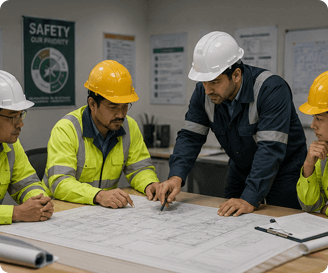
That isn’t just a maintenance problem. It’s a leadership problem.
Clause 5: Leadership and Worker Participation expects managers to provide resources, remove barriers to safety, and encourage workers to report concerns without fearing they’ll be ignored.
The investigation uncovers another issue. A contractor working in the area had completed the mandatory induction, but nobody explained that the platform became hazardous during wet weather.
The training records were complete.
The worker’s understanding wasn’t.
That’s where Clause 7: Support becomes relevant. ISO 45001 expects organisations to ensure workers are genuinely competent, not simply present for a training session. A signed attendance sheet is useful evidence, but it doesn’t guarantee someone understands the risks they’ll face.
The Investigation Is Only Half the Job
The investigation identifies three immediate causes: a slippery surface, delayed maintenance, and inadequate communication with the contractor.
Many organisations stop there.
ISO 45001 doesn’t.
Clause 10: Improvement requires organisations to identify root causes, implement corrective actions, and confirm those actions actually reduce future risk.
Replacing the flooring addresses today’s hazard. Updating inspection schedules, improving contractor inductions, and assigning ownership for maintenance requests strengthen the system itself.
The goal isn’t to close an investigation. It’s to prevent the next one.
Good Safety Systems Keep Watching
A month later, the platform has been repaired. New anti-slip grating has been installed and warning signs are in place.
Is the problem solved?
Not necessarily.
Clause 9: Performance Evaluation requires organisations to monitor whether their controls continue to work. Internal audits, inspections, workplace observations, and management reviews all help answer questions such as:
- Are similar hazards appearing elsewhere?
- Are corrective actions being closed on time?
- Are workers continuing to report concerns?
- Are inspections identifying recurring issues?
Safety performance isn’t measured only after an incident. It’s measured every day.
Where Many Organisations Fall Short
None of the failures in this story happened because people didn’t care.
Workers noticed the hazard.
Maintenance requests existed.
Training had been conducted.
The investigation was completed.
Yet someone was still injured.
The real problem was that information remained scattered across meetings, emails, spreadsheets, and paper records. Each activity happened independently, but no one connected the dots before the incident occurred.
That’s a common weakness in many occupational health and safety management systems. The individual processes exist, but they don’t operate as one system.
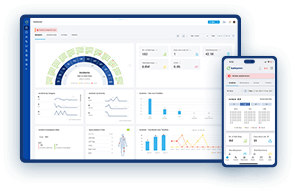
Digital safety management platforms help close those gaps by connecting hazard reporting, inspections, incident investigations, corrective actions, and performance monitoring into a single workflow. Instead of reacting after an injury, safety teams gain visibility into emerging risks while they can still do something about them.
The Real Lesson Behind ISO 45001:2018
If there’s one lesson from this story, it’s this.
The worker didn’t fall because the platform was wet.
The worker fell because several opportunities to prevent the incident were missed long before anyone stepped onto that platform.
That’s the real purpose of ISO 45001:2018. It isn’t to produce more documentation or prepare organisations for an external audit. It’s to build a system where hazards are identified early, workers are heard, leaders respond, and every incident makes the workplace safer than it was before.
When those pieces work together consistently, certification becomes a by-product rather than the goal.
For organisations managing safety across multiple locations, platforms like Safetymint make it easier to put these principles into practice by connecting inspections, hazard reporting, investigations, corrective actions, and management reviews into one continuous process.
This article was generated with the assistance of AI and reviewed by Ramesh Nair for accuracy and quality.