
PDCA in Safety: Turning Incidents Into Improvements
One incident gets investigated. Corrective actions are assigned. The report is closed.
A few months later, a similar incident happens again.
If that sounds familiar, the issue may not be the investigation itself. It may be what happens after it. Too often, organizations treat safety as a series of isolated activities instead of an ongoing process of learning and improvement.
That’s where the Plan-Do-Check-Act (PDCA) cycle in safety management makes a real difference. Rather than reacting to individual events, it provides a simple framework for identifying risks, putting controls in place, measuring whether they actually work, and improving them over time. Whether you’re managing a construction site, a manufacturing plant, or multiple facilities, PDCA helps turn every incident, inspection, and audit into an opportunity to build a safer workplace.
What Is the PDCA Cycle in Safety Management?
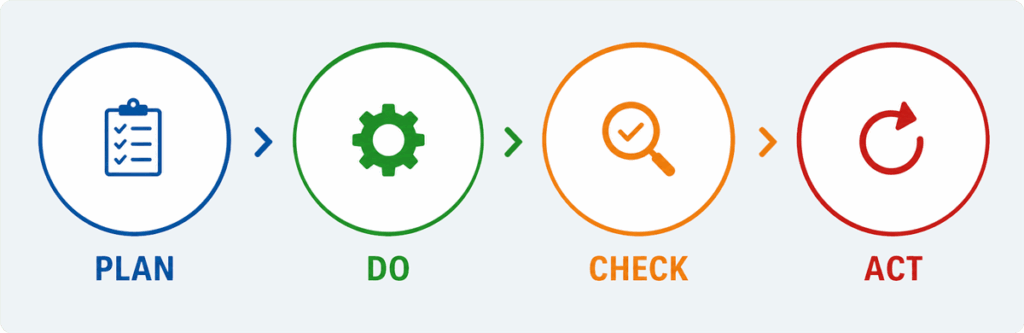
The Plan-Do-Check-Act (PDCA) cycle is a continuous improvement method used to strengthen workplace safety. Instead of waiting for an incident to expose a weakness, it encourages organizations to plan carefully, implement controls, measure their effectiveness, and improve them based on what they learn.
Originally popularized in quality management, the PDCA model has become a core principle of modern safety management systems, including ISO 45001. The reason is simple. Safety risks change over time. New equipment is introduced, work methods evolve, contractors come and go, and regulations change. A safety programme that isn’t regularly reviewed can quickly become outdated.
PDCA keeps safety management active rather than reactive.
The Four Stages of the PDCA Cycle
Plan: Understand the Risk Before Taking Action
Every improvement begins with asking the right questions.
What hazards exist? Which activities carry the highest risk? Have similar incidents happened before? What controls are already in place, and where are the gaps?
This stage involves gathering information before making decisions. Safety managers may review incident reports, conduct risk assessments, inspect work areas, analyse inspection findings, or speak with the people performing the job every day.
For example, imagine a warehouse that has reported several forklift near misses over the past six months. Instead of reminding drivers to “be more careful,” the safety team studies traffic flow, identifies blind spots, and develops a plan to redesign vehicle routes while improving pedestrian segregation.
Good planning focuses on solving the real problem, not just the visible symptom.
Do: Put the Plan Into Practice
Once a solution has been identified, it needs to be implemented consistently.
That could involve introducing a new inspection checklist, updating a permit to work process, installing physical barriers, conducting refresher training, or revising operating procedures.
This is often where organizations invest the most effort. But implementation alone doesn’t guarantee improvement.
A new safety procedure that isn’t followed consistently delivers little value. Workers need to understand why the change was made, supervisors must reinforce it, and management should provide the resources needed for successful execution.
Check: Measure What Changed
This is the stage many organizations overlook.
After new controls have been introduced, it’s essential to verify whether they are actually reducing risk. That means collecting evidence instead of relying on assumptions.
Useful indicators include:
- Incident and near miss trends
- Safety inspections
- Audit findings
- Behavioural observations
- Corrective action completion rates
- Feedback from employees and contractors
Returning to the warehouse example, the safety team reviews observations over the next two months. Near misses have reduced significantly, but inspectors notice that temporary contractors continue using the old traffic routes. The improvement worked, but not for everyone.
Without checking the results, that gap might never have been discovered.
Act: Improve and Standardize
The final stage turns lessons into lasting improvements.
Successful changes should become part of standard operating procedures, training programmes, and future planning. If results fall short of expectations, the cycle begins again with a revised plan.
This is also the right time to share lessons learned across departments or project sites. An improvement that solved a problem in one location may prevent an incident somewhere else.
The goal isn’t simply to close corrective actions. It’s to make sure the same issue doesn’t return.
A Practical Example of PDCA in Action
Consider a construction company experiencing repeated slips around material storage areas after heavy rain.
| PDCA Stage | Safety Activity |
| Plan | Review incident reports, inspect the work area, identify root causes. |
| Do | Improve drainage, relocate stored materials, install anti-slip walkways, brief workers. |
| Check | Monitor inspections, observations, and near misses over the following month. |
| Act | Update site procedures and apply the same controls across all projects. |
Notice that the incident wasn’t simply investigated and forgotten. It became the starting point for improving the entire process.
Common Reasons the PDCA Cycle Falls Short

The framework itself is straightforward. Applying it consistently is where many organizations struggle.
Some of the most common mistakes include:
- Treating incident investigations as the end of the process.
- Closing corrective actions without confirming they are effective.
- Measuring completed activities instead of safety outcomes.
- Failing to involve supervisors and frontline workers.
- Reviewing performance only during scheduled audits.
- Repeating the same corrective actions without addressing the underlying cause.
PDCA delivers results only when every stage receives equal attention. Skipping the review stage or rushing corrective actions weakens the entire cycle and increases the chance of repeat incidents.
How Safety Software Supports the PDCA Cycle
Managing continuous improvement with spreadsheets, emails, and paper records becomes difficult as an organization grows.
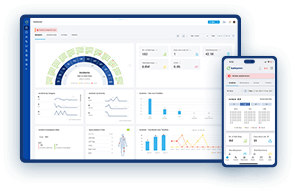
A digital safety management system connects every stage of the PDCA cycle within a single platform.
| PDCA Stage | How Digital Safety Software Helps |
| Plan | Capture hazards, conduct risk assessments, schedule inspections. |
| Do | Assign corrective actions, manage permit to work processes, document safety activities. |
| Check | Monitor dashboards, analyse trends, review audits and inspection findings. |
| Act | Track corrective actions to completion, verify effectiveness, share lessons learned across teams. |
Instead of searching through disconnected reports, safety managers gain a complete view of how risks are identified, controlled, reviewed, and improved over time.
Solutions like Safetymint support this approach by bringing incident reporting, inspections, permit to work, corrective actions, and analytics into one integrated system. The result is a safety programme that doesn’t just respond to incidents but continuously improves because of them.
Turning Safety into a Continuous Process
The strongest safety programmes aren’t built on incident investigations alone. They’re built on what happens after the investigation is complete.
Every hazard identified, inspection conducted, audit completed, or near miss reported creates an opportunity to improve the way work is planned and performed. The PDCA cycle in safety management provides a practical framework for capturing those lessons and turning them into better decisions, stronger controls, and fewer repeat incidents.
Continuous improvement doesn’t require dramatic changes. It requires consistent ones. Organizations that follow the PDCA cycle make learning part of everyday operations, ensuring that every improvement strengthens the next cycle and helps create a safer, more resilient workplace.
This article was generated with the assistance of AI and reviewed by Ramesh Nair for accuracy and quality.